Chord Dave and M Scaler: why I preferred Dave alone
I owned a Chord Dave and, for most of that time, a Chord Hugo M Scaler with it. Almost everyone on the forums told me the M Scaler would make Dave better. To my ears it did the opposite: Dave on its own sounded more natural, and I liked it more. I sold both together on Head-Fi, for about what I had paid. Today I listen through an Apogee Symphony Desktop and studio monitors.
This is not a review. I don’t have the gear any more, and I can’t measure it. It is one owner’s story, told as honestly as I can remember it, with the parts I am not sure about marked as such. It was written from my answers to a long list of questions, with AI help for the structure, the English and the forum research. Where a paragraph reports what other owners say, it says so and links to them. Everything in the first person is mine.
How I got to Dave
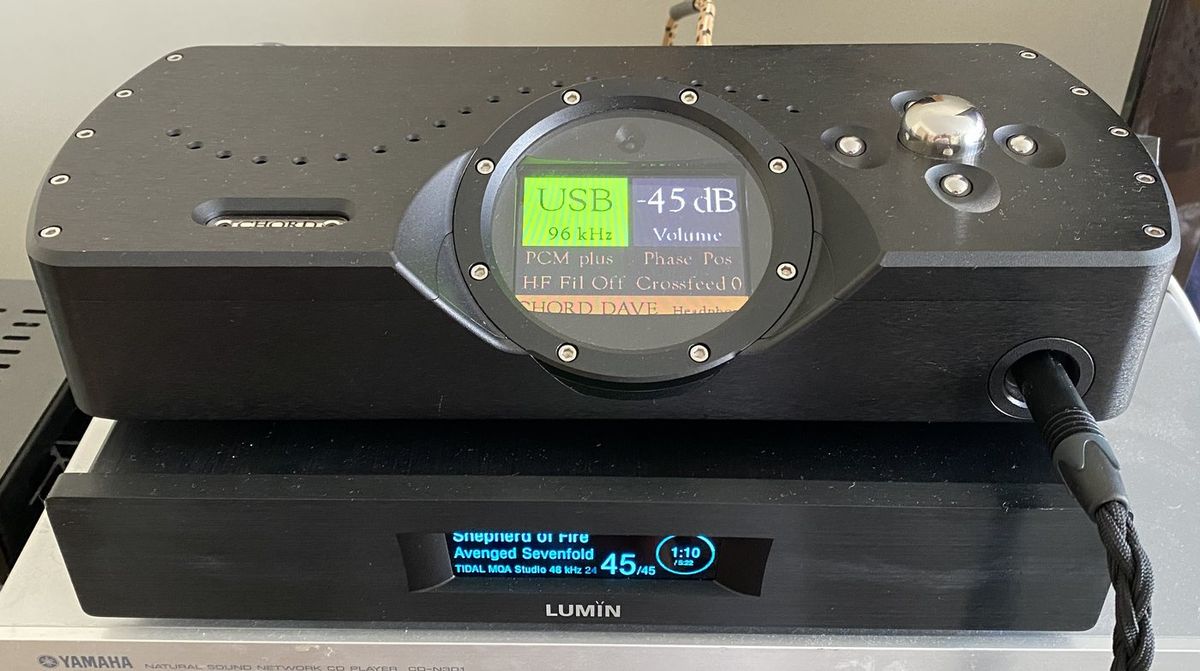
Before Dave my DAC was a Sonnet Morpheus. I borrowed a Dave from a music shop I know and listened at home first. Then I bought one used, lightly used, for a bit less than a new one.
The Morpheus sounded thick to me. Not warm, thick. Simple, heavy, a bit “digital”. I like a finer, more detailed sound, and Dave was exactly that. Next to the Morpheus, Dave had more treble, and it was clearer and fuller. It did not depend on the track or the genre. It was better on everything I played, and I play mostly rock and metal.
I am a treble head. I want a lot of detail up top: the small differences between cymbals, each hit on its own. That matters for the rest of this story.
My system at the time
A Lumin streamer fed Dave, and Dave sat on a chest of drawers in the living room. I used it two ways: straight from its own headphone output, or into a Wells Audio Milo amplifier. I never used it with speakers.
My headphones then were an Abyss 1266 and a ZMF Verite Closed, which I liked a lot. The Abyss always went through the Milo. Straight from Dave it was not a disaster, but it lacked power. Through the Milo it was clearly better and stronger.
The numbers in this site’s database agree with that. The Abyss 1266 TC is a 50 Ω planar at 88 dB/mW, so it needs about 16 mW and 0.9 V for a 100 dB peak — far more than most headphones here. Wells Audio rates the Milo at 12 W into 32 Ω. That is the kind of headroom the Abyss likes.
One odd thing about the Milo: its left and right channels were swapped inside. I had to plug the cables in the other way round to get the channels right. I still find it hard to believe a maker would build an amplifier like that, and I don’t think anyone had been inside mine before me.
The balls and the menu
Dave has no normal display. It shows sample rate and settings with coloured balls and a small screen that is more art than information, and many owners complain about it. I liked it. It was so strange that it was fun. Dave also runs warm, and owners talk about that a lot. It never bothered me. Everyone’s Dave gets warm and keeps working, so I didn’t think about it.
Adding the M Scaler
I bought the M Scaler at almost the same time as Dave; it arrived maybe two weeks later. It was used too, and I think I paid about half of the market price. The reason was simple: the forums. Everyone praised it.
This is roughly what owners write. The M Scaler is Rob Watts’ upsampler. It runs a very long filter, about a million taps, and sends Dave a 705.6 or 768 kHz signal over two BNC cables. Owners describe the result as more weight, more depth, more ease, and a sound that is more analogue and less digital. On Audiogon one owner described it as being about weight, balance and a relaxed kind of naturalness rather than extra clarity (Audiogon thread). On Head-Fi, in Rob Watts’ own “Watts Up...?” thread, many treat the combination as the high point of Chord’s line.
What I heard
It was different, yes. But not in the way I hoped.
Dave on its own sounded more analogue to me. Natural, smooth, gentle, and nicely presented. With the M Scaler the sound became hard, raw and strong. Not sharp exactly. Strong. But in places it was sharp-strong too, and rough. That roughness is what I disliked most. It wasn’t about dynamics. It was the texture: grainier, harsher.
It also changed the balance. The midrange came forward, all the sounds in it got pushed up, and that midrange covered the treble. For a treble head that is the worst trade. The top end felt flatter and less present.
Funny enough, the M Scaler reminded me of the Morpheus I had just left. Same kind of sound, the kind I don’t like. The tendency was there on every pair of headphones. Each pair has its own signature, so the size of the change varied, but the direction was always the same.
Two weeks of trying to like it
I tried hard. I had just paid for it, so I wanted to make it work at any cost. For about two weeks I swapped BNC cables, tried ferrite rings and so on. In that time I almost stopped listening to Dave on its own. Everything was “how do I make the M Scaler sound right”. After those two weeks I gave up and decided I liked Dave better without it.
I am not the only one
Most owners love the pairing, but not all. On the Naim forum, an owner who ran Dave with and without the M Scaler for about a year wrote that bare Dave sounded more natural on most recordings, especially heavily produced music, where the M Scaler struck him as clinical and artificial. He sold his M Scaler (Naim community thread). On Audiogon, another Dave owner bought one, found that pass-through mode sounded best, and took it out of the system. His view, roughly: the better your DAC, the less an upscaler can add (Audiogon thread).
Heavily produced music is most of what I listen to. Metal is about as produced as it gets. So maybe that is part of it.
The cable rabbit hole
The M Scaler connects to Dave with two BNC coaxial cables, and owners argue about them a lot. One cable comes up again and again as “the one”: the Wave High Fidelity Storm Reference BNC, which Rob Watts is often said, without a source, to use himself. Others say the stock cables are fine, or that a cheap step up is all you need — Supra Trico, Moon Audio Silver Dragon, even Belden or Canare video cable. One owner bought an expensive Wave and went back to stock. Some suggest clip-on ferrites on the BNC cables to cut RF noise (Roon community thread, StereoNET thread).
My cables were not Chord’s, and not expensive. I don’t remember the brand. I put ferrite rings on them. Someone on Head-Fi wrote that with ferrites my cheaper cables would sound like the famous expensive ones. Maybe they did. I still didn’t like the sound.
Did the ferrites change anything? I think maybe a little. But I’m not sure. And here is the honest part: the link between the M Scaler and Dave is digital. It carries data, not an analogue signal. If it were analogue, rings and cables could plausibly change the sound. On a digital link, in theory, they should not, unless you believe the RF-noise argument. So I can’t rule out that my brain heard what it expected to hear.
I never tried power conditioners, power cables or anti-vibration feet. To be honest, that kind of audio voodoo embarrasses me. Anti-vibration I could at least understand if there were vibrations. But this is not a CD transport. What would it vibrate from?
Hugo 2: the one I kept
I still have a Chord Hugo 2. I bought it used — in fact I have bought and sold one three times. It has less power than Dave and is a little lower in quality, but for such a small box it served me very, very well. I used it mostly for IEMs, not full-size headphones; for those the Milo did a better job, with more power. For IEMs it is excellent, I’d say comparable with the best portable players on the market.
For the record, the database here lists the Hugo 2 at 740 mW into 32 Ω and 94 mW into 300 Ω, with an output impedance of 0.025 Ω and 2.6 µV of noise, all from Chord’s own documents. That low impedance is why it suits sensitive multi-driver IEMs so well.
My current unit has a fault: noise in the left channel. The first diagnosis was that the main board needs replacing, which would cost more than I paid for the used Hugo, so I left it as it is. On full-size headphones you barely hear it, especially harder-to-drive ones. On IEMs you hear it more — not during the music, especially metal, but in fade-outs and pauses.
After Dave: an Apogee
About a month after I sold Dave I bought an Apogee Symphony Desktop and set up a parametric EQ. Then I started to feel that Dave had been selective. It brought some sounds forward and pushed others back.
One example: Carcass, “Heartwork”. Right at the start there is a soft cymbal hit in one channel. On Dave I could barely hear it. On the Apogee it is clear. To be fair, I never had both at the same time, so this is from memory, and the EQ was on when I heard it on the Apogee.
What I gained with the Apogee is naturalness, and an honest picture of the recording. On Dave some sounds were a little exaggerated at the cost of others. Here everything sounds roughly how it should. That is my subjective impression, not a measurement. I should be fair to the Apogee too: I think even it is more than I needed. A cheaper interface would probably sound almost the same.
Why I sold it
A recording engineer told me I could get the same sound from an audio interface, at a fraction of the price, if I set it up right. For me, he was right. I don’t regret selling it.
The money
I bought both used, almost together, and sold them together after a few months — half a year at most. A buyer on Head-Fi took them within about a week, and I got roughly what I paid, so owning them cost me almost nothing. Even so, looking back, I’d call all of it money I didn’t need to spend. The same result can be had much cheaper.
Today I wouldn’t buy either of them. Well, if I had a lot of money to spare, I might buy a Dave again, out of sentiment. I just love how Chord gear looks, and to me Dave looks stunning. But with the Apogee already here, the money would go on better studio monitors, which would still make a real difference for me. My KRK Rokit 8s work for metal, but they are not special.
Who Dave makes sense for
I don’t think anything has changed. Dave still makes sense for audiophiles who are searching, chasing their own rabbit. It also makes sense if looks matter to you. Dave looks futuristic, strange, great. Someone visits, sees it, and goes “wow”. A small interface hidden somewhere has none of that, and for some people that matters. Marketing sells too.
In the end, the sound I wanted came from a plain box that nobody would look at twice.
If you are saving for one
You don’t have to buy it right away. And you don’t need an expensive interface like my Apogee either. Think about whether some other, in-between device would be the better choice for you.
The rest of the path, from iBasso IEMs to the Apogee · What the recording engineer actually said